Thursday, August 30, 2007

The Human Stain


written by Philip Roth

When this book caught my eye at the library, some murky corner of my memory told me that I'd heard of it (or was it just the movie by the same name?)... anyway, I vaguely remembered it being acclaimed by ... someone, I don't know who. After reading the back cover, I was intrigued enough to check out the book: it details how a dean at an upper-crust New England university gets ousted for purportedly being a racist, despite the fact that his secret and shocking personal history "would astonish his most virulent accuser." In a nutshell (spoiler warning!), he's actually black — but because his skin and features are not profoundly African-American, he has spent most of his adult life passing himself off as a white man with Russian Jewish roots.

Kind of an interesting premise, but I generally did not like this novel. One reason was that Roth's writing felt quite laborious to me (sentences spanning several lines - enough to send a technical writer running)... but the bigger reason I disliked it was because there was just too much offensive vulgarity. And before you accuse me of being too prudish, I need to say that yes, I do get the fact that modern literature usually has a hefty dose of sexual themes. But this book just contained far too much desperation and sleaze for me. The main character, Coleman Silk, reminded me a lot of the protagonist in Disgrace, by J.M. Coetzee: an intelligent, mature, seemingly respectable man who, just under the surface, is disturbingly immoral. Still, like the Coetzee book, there were some pockets of great writing that did make me want to keep reading.

Of note:
  • I could not get a clear picture of Faunia Farley, Coleman Silk's mistress. She seemed like an utterly unknowable character in this story. Maybe that was the way the author intended it? She was, after all, a woman with a very troubled life and appeared (to me at least) to have some incredibly complex social problems. Maybe her unknowableness was an intentional reflection of that.

  • There is a really brilliant section of the book in which Faunia observes and contemplates crows. I know it sounds funny, but I found it to be such a profound and symbolic passage. And then Roth artfully closes the loop on the symbolism by bringing it back in near the end of the book. It was very cool. You have to read it to understand what I mean.

  • Coleman Silk has a colleague at the university, a Pariesienne-born female professor, who takes up way too much of this book. She is a sub-plot that feels very unnecessary to me, and the long sections on her foibles really drag.

  • Also unnecessary was any mention of Bill Clinton and Monica Lewinsky. I'm not sure why that had to be a backdrop to the story. It was annoying.
Bottom line: I wouldn't recommend this book. Am I getting cranky? I haven't read any real you-must-read-this books lately...

Sunday, August 26, 2007

Once Removed


written by Mako Yoshikawa

I am not above being drawn to a book by its cover. The art on this novel's front, along with its title, made me curious, so I checked it out from the library in hopes that it would be a good summer read. After a few difficult starts (my fault, not the book's - life is just too busy sometimes to get engrossed in a new book without some effort!) I re-started and finished this book while Jay and the kids and I were visiting my in-laws in Maryland.

The story is mainly about a whole bunch of conflicted women. Two of them are stepsisters (Claudia and Rei) and though they forged a deep relationship as children when the dad of one married the mom of the other, the parents divorced when the girls were both 17. The girls consequently drifted apart. The book picks up 17 years later when they rekindle their relationship. The main thread of the novel, though, is not really about Claudia's relationship with Rei, but rather the tension between Claudia and Hana (Rei's mother and Claudia's stepmother).

Of note:

  • One of the reasons I found it hard to get engaged in this book from the beginning is because there is such a complicated web of relationships to keep track of: the two sisters, their own natural parents, the parents' former spouses... and then there's also a persistent romance between Claudia and a married man, so you'll need to keep track of his wife and children in the mix. Interestingly, though, this kind of complexity is a reflection of real life, with so many of us being part of blended families and step-relationships.

  • The title is clever, given the story line. And like I suspected, the art on the cover does have some significance to the story.

  • Rosie (Claudia's natural mother) feels like a flat, incomplete character to me. Even though her role becomes bigger toward the end of the book, we never really get a clear picture of what kind of person she is.

  • On the other hand, the author portrays Henry (Claudia's natural father) with great clarity. Her descriptions of his mannerisms and personality were really vivid.

  • The author draws interesting parallels between Hana as the "other woman" who broke up Claudia's parents' marriage, and Claudia's own relationship with Vikrum, a married man. I especially found it intriguing that both of these illicit relationships were intercultural.

  • There is a lot of looming, unresolved drama surrounding Hana's experience as a girl when she witnessed the Hiroshima bombing. The novel implies that Hana's choice to keep her experience a secret is what led to her marriage dissolving. Huh? I don't get that.

  • The back cover of the book is full of hyperbolic adspeak, particularly the last paragraph, which claims that the novel "Tak[es] us from the exotic Japan of the 1940s and '50s, to the verdant English countryside, to the urban streets of Boston..." Come on now! The book is about relationships, not locales! In fact, I had to think hard to remember what part of the book even took place in the "verdant English countryside."

  • There are big (and sometimes painful) observations here regarding love, marriage, devotion, and betrayal.

Friday, July 20, 2007

Our Lady of the Forest


written by David Guterson


This was a pretty funky book, the funkiness probably compounded by the fact that I read it in one sitting, immediately after a week-long solo hike on the Appalachian Trail, when my head was still spinning from walking out of the woods and back into the frenetic buzz of civilization.
The novel deals with a homeless teenage runaway named Anne Holmes who, while hunting for mushrooms in a remote area of the Pacific northwest, encounters several Marian apparitions. She confides mainly in two people: a fellow wanderer named Carolyn who doesn't really believe in the apparitions but is excited about the potential financial benefits, and a confused young priest who is struggling with doubt and his role in the church.


Of note:
  • I liked the way Guterson develops such a vivid picture of the depressed logging town where the story takes place. North Fork is definitely a gloomy place in need of redemption, and this becomes all the more apparent when Anne's visions create such a swell of activity and hope. North Fork kind of reminds me of some of the towns I've seen in the upper peninsula of Michigan. Towns that have lots of history but are now sadly languishing under economic hardship and loss of purpose.

  • The character of Tom Cross, an unemployed logger with all kinds of problems, is intertwined with Anne's visions, but his story felt underdeveloped to me, and his abrupt transformation in the end of the book seems very trite and unsubstantiated.

  • The priest in whom Anne confides has a complicated sexuality that I found really bothersome to the story. And yes, I know there's a point to be made here about how those trained and chosen for sacred work (like the priest) are sometimes much less qualified and much less spiritual than mundane but faithful riffraff (like Anne). But the constant references to the priest's issues with lust and masturbation got old.

  • I think the book makes an interesting point made about how society is quick to grope for the miraculous, and to turn spiritual phenomena into commercial ventures. Once word gets out about Anne's visions, miracle-seekers from all over the surrounding area start coming out of the wordwork, turning Anne's experiences into frenzied media-worthy events.

Sunday, June 10, 2007

A Walk to Remember


written by Nicholas Sparks

In preparing for my June backpacking trip, I stopped at the library in search of some light reading, literally and figuratively. I needed something that wouldn't require too much concentration and wouldn't add too many unnecessary ounces to my backpack. This book met both requirements, so I added it to the small pile of stuff on my ping-pong table that I would eventually shoehorn into my pack (which, incidentally, ended up tipping the scales at a mere 27.5 pounds, even after adding the book).

It was classic Nicholas Sparks - definitely a chick book, and a tearjerker on many levels. If you haven't read any of Sparks' books, think Message In a Bottle, the movie from 1999, which was based on one of his novels.

This story's about an unlikely match between two high-school students in the 1950s: an affable, underachieving boy and an angelic but dowdy and hyperreligious girl. In a sweet but far-too-perfect romance, they end up facing a horrific situation together (spoiler warning): she finds out she has leukemia and has only a short few months to live, but they end up marrying anyway.

Lots of cliche here, to be sure, but if all you want is a quick read and don't mind the schmaltz, it's not bad. As for me, it suited me fine for a backpacking trip (anything that doesn't mention bear attacks or predatory mountain dwellers pretty much qualifies as okay reading) but I don't know if I'll be shopping for more Sparks books.

Friday, June 01, 2007

The Sacred Journey: A Memoir of Early Days


written by Frederick Buechner
This is the first of three autobiographical works by Frederick Buechner. (Although I think he would argue that there's a bit of autobiography in each of his books, even the novels.) It's a very compelling story, this candid retelling of how he came to faith. He strings together bits of childhood memories and recollections of his early adulthood, and in the process points to how many of the events of his life - both the overtly significant ones and the seemingly mundane ones - guided him along a path (without his knowing it) that culminated in his realization of God's active and loving presence in his life.

Particularly powerful, I think (and this is a spoiler, so be warned!) are Buechner's ponderings about his father's suicide. If you have been affected yourself by the suicide of someone close to you, I think you might find his perspective interesting - maybe even healing.

Unlike some of his other stuff, this book is easy and quick to read. You'll find yourself doing a lot of your own self-reflection as you read his impressions and thoughts about God and life. You will see yourself in this book. But you won't feel preached at or proselytized. In fact, if you're like me you'll probably find it extraordinarily refreshing that Buechner doesn't purport to have all the answers to life's hardest spiritual questions; nor does he persuade you to join up with any particular line of thinking, or make you feel less-than-worthy if you disagree with him.

Wednesday, May 23, 2007

Telling the Truth

written by Frederick Buechner

One of my college literature professors, Jeff Duncan, has been on my mind recently, and here's why. I went on a cleaning rampage last month, one of my chief missions being to reduce the size of my burgeoning library. As I was doing some tough love on the bookshelves, I came across Frederick Buechner's Telling The Truth, which Duncan kindly gave me when I was the ripe age of 21. At that time I tried my darnedest to slog my way through it, and I remember being a bit bewildered and confused, thinking: perhaps one day I'll understand some of what this guy is saying. If memory serves, I don't think I made it through the entire book.

Fast-forward 16 (oy!) years, and there I sat in my home office, trying to decide whether to keep the bloody book or move it on. I decided to give it another try, and whoa. It was somehow both jarring and gentle at the same time. I guess some things are just more compelling now that I "have a little age on me," as my dad used to say.

Buechner spins the gospel in light of human failure (tragedy), the hilarity of God's free gift of redemption (comedy), and the amazing truth of how in the end there is resolution and good really does triumph over evil (fairy tale).

Now I find myself on a steady diet of Mr. Buechner's other works - fact, it's been all Buechner all the time around here lately, and for that I have Duncan to thank. It's funny how sometimes God starts a little something in us and then waits around patiently — sometimes years! — while we dilly-dally, drinking nothing but milk for far too long but then finally one day accepting a few morsels of solid food.

I'm so grateful not just for the book Duncan gave me, but that he had the guts to give a flighty, self-absorbed student something to ponder. It took me a while, but I'm pondering now.

Wednesday, May 16, 2007

Blue Like Jazz

written by Donald Miller

This book came on recommendation from my friend Dave. Every Tuesday morning, Dave and I supervise the dropoff area at our kids' school while solving most of the world's problems in about 30 minutes. One of our favorite woes to discuss is how the church (universal) has become pretty dogmatic and in many ways irrelevant to the rest of society. Hence this book.

The author, Donald Miller, wrote this book as a commentary on "Christian spirituality" - which he carefully differentiates from what you and I think of as mainstream evangelical Christianity. He equates Christian spirituality to jazz music, saying that he never used to like jazz because "it doesn't resolve." But after exeriencing God in a multitude of ways outside of the usual boxy white-bread evangelical Christian paradigms, he comes to know and love Jesus in a different way. A way that still "doesn't resolve" but is embraceable nonetheless.

Of note:

  • The premise of this book is sort of "Velvet Elvis lite." Which is pretty arrogant for me to say, actually, now that I think about it, since I haven't even read all the way through Velvet Elvis yet. (Jay has though - and isn't that almost the same thing?) Anyway, one of the themes is this: what you're used to thinking of as normal, right, Christian living might not be normal, right, or Christian.
  • Donald Miller's style was refreshing to me for about the first 20 pages. Then it got annoying. The guy needs an editor. Badly. Some of the essays in the book read like a Junie B. Jones story.
  • One of the biggest things in the book to resonate with me was how Miller describes his ineptness at living out biblical community. I feel like he is describing me as he compares his life to a movie with just one central character: "Life was a story about me because I was in every scene. In fact, I was the only one in every scene. I was everywhere I went. If somebody walked into my scene, it would frustrate me because they were disrupting the general theme of the play...the movie, the grand movie, was about me... that is the way I lived." That was, and unfortunately to a great extent, still is, the way I live.
  • The other big thing I loved about this book is how he blasts the traditional notion that to be a Christian, you have to be a right-wing Republican, hate homosexuals and hippies, and never question or doubt. Who can live like that, really?

Monday, April 30, 2007

The Life and Times of the Thunderbolt Kid


written by Bill Bryson

I picked up this book because I thought I loved Bill Bryson. Certainly I did love A Walk in the Woods and have also enjoyed portions of A Short History of Nearly Everything and some of his travel writings. He's famous for his ability to capture the humor and idiocy of the places and people he visits, and Thunderbolt makes this evident - only this time it's not a travelogue of a physical journey, but a journey of his growing-up years.

But his writing, to me, falls short this time. It's funny but not funny. Part of it's a generational thing; I think people of Bryson's generation (who grew up in the fifties and sixties) might get more out of this book than I did. Some of the story line just felt plainly uninteresting, since the events of the time didn't hold personal relevance for me. And although the typical Bryson humor is there, I grew weary of his overused hyperbole. Sometimes it just felt like he was trying way too hard to be funny. Some of the humor was even annoying or offensive, like the frequent cutting references to the "fat kids" he grew up with, or the parts about constantly trying to persuade his classmate Mary O'Leary to disrobe.

After reading other Bryson stuff, this book felt like a disappointment. Like a quick, thrown-together patchwork of some of his childhood memories, with no real point to the story. If he hadn't already made a name for himself with his previous work, I don't think this book would be that big of a seller.

Saturday, April 14, 2007

How to Be Lost

written by Amanda Eyre Ward

This is perhaps the first time since high school that I've read an entire novel in under 24 hours. But I guess anyone could pull that off if trapped on a tour bus for most of a day. I brought this book along on the one-day Grand Canyon excursion that Janet and I signed up for while we were in Las Vegas for a few days. (The heck with Girls' Night Out — how about a Girls' Weekend Out!) Since the drive time between Vegas and the Grand Canyon is a staggering 4.5 hours across a barren desert, this book is what prevented me from going catatonic while listening to the torturously bad jokes of the tour bus driver.

I'd first heard of this novel from Cindy, who read it during our backpacking trip through Great Smoky Mountain National Park last spring. I remember her being both engrossed in this book and shocked by some of its twists. It sounded to me like a good "chick" book.

It's about a girl named Caroline Winters whose younger sister Ellie vanishes at age 5. The family basically falls apart in the ensuing years. Much later, when Caroline's an adult, her mother shows her a page out of a magazine, and in the background is a woman who the mom thinks is the missing sister. Caroline ends up going on a quest to Montana to find the woman.

Of note:
  • The style of this book is very Jodi-Picoult-ish, which Janet and I decided is a pretty common theme lately in new novels. You get a fairly close and disturbing look at a dysfunctional family with many layers of problems, and there's not a necessarily tidy ending. You also get to see things from multiple people's perspectives, which I always find kind of cool.
  • There are some wandering side plots that go nowhere. (The following might be a spoiler if you plan to read this book.) A major example is when Caroline finds the woman she thinks is Ellie but it ends up being someone who just looks a little like Ellie. The mistaken identity becomes obvious to the reader pretty early on, yet the story lingers way too long on this. Other annoying tangents that take up too much of the reader's time include the premature birth of Caroline's niece, her (other) sister's rocky marriage, and the sudden death of Caroline's mother.
  • The ending was abrupt and lame. Definitely a lot of unfinished business and loose ends. I got the feeling that the author's publishing deadline was looming or something, and she just stopped writing.
  • I loved the character of Agnes Fowler and the way the author revealed her personality through letters. I'm a bit embarrassed to say that Agnes reminds me a little of myself. Trusting, naive, very un-savvy in many ways, yet fairly competent in other ways. For the record, though, I must clarify here that, unlike Agnes, I have never visited a website called AlaskaHunks.com.

Friday, April 13, 2007

Reading Lolita in Tehran


written by Azar Nafisi

My friend and stepsister Terry gave me this book. Back in January we endured a very long day together at St. Joe's hospital as we waited for the ER doctors to figure out what to do with my very ill, very frail stepmother. (Which, believe me, is another story for another blog altogether.) As a diversion, we began chatting about what we'd been reading lately, and Terry found out that I had this book on my must-read list because I'd heard good things about it from Jay's mom. She promptly ran out to Borders and bought it for me.
It's a compelling true story about Azar Nafisi, an Iranian professor of literature, who weathers a turbulent and socially repressive period of political upheaval in Iran. Sadly, she quits her job at a university in Tehran due to the rampant Islamic authoritarianism and the rigid restrictions placed upon women. As a means of promoting and affirming the right to independent thought, she assembles a small group of women who believe in the power of literature, and conducts a makeshift class once a week in her home. The book is a memoir of those difficult years, told through a discussion of the novels they read together.

So the book is really a combination of literary criticism and poignant memoir. Woven throughout is Nafisi's political commentary about the transformation of Iran from a vibrant, progressive nation to one where much of the population is manipulated through repression and intimidation. It's a sad, disturbing glimpse into a society that attributes very little value to women.

Of Note:
  • Overall, I felt very uneducated as I read this book, mainly on two levels: (1) I know very little about the political and religious history of Iran, and this book places you smack dab in the middle of the Iranian revolution. (2) I used to think I knew something of great literature, but after reading this book I realize I know next to nothing. Of the many novels that the author weaves into her memoir, I recognized the titles of maybe two in ten. Maybe.

  • The one big take-away that I LOVED in this book is the message that literature, even if it portrays immoral people or bad behavior, does not in itself corrupt the reader. The Islamic regime in Iran wanted to prohibit citizens from reading such controversial stories as Pride and Prejudice and Lolita because the assumption was that if you read that stuff, you become just like the main characters (i.e., you read about sin, you become sinful). Interesting that some ultra-conservative Christians would say the same thing! I'm not saying that I necessarily recommend or embrace the particular novels Nafisi mentions, but I do believe that reading literature can only open our eyes and our minds, helping us to contemplate issues of truth and justice in a way that allows us to see for ourselves what is right.

  • She makes reference several times to "her magician" -- a man who was a champion of free thought but who had intentionally withdrawn from the educational and social system in Iran. He is her sometimes-friend, sometimes-counselor, sometimes-colleague. I found it weird that she portrayed him as some kind of mysterious, Yoda-like being. He was underdeveloped and too murky of a character for me to understand or connect with.

  • I found it interesting that there was not a lot of Persian pride, language, or culture woven into the story. Have you noticed that some stories that take place in non-English-speaking locales are filled with the language and imagery of the protagonists' ethnicity? Not this one. In fact, I would even say that the author goes to some length to show that she and her proteges think and act very much like the typical Western citizen, except that they live under a restrictive totalitarian regime. There are very few references to Persian foods (she does mention eating Western goodies, though, such as sandwiches and ice cream) and very few instances where she uses Persian epithets or Persian words. Rather than drawing attention to the uniqueness of Iranian culture, it feels to me like she instead draws attention to the fact that Iranian people, if left unrepressed, would be essentially the same as American people. I'm not saying this is a bad or incorrect view; just notable different than the style of many other foreign authors.

  • The story meanders; there's no nice way of saying it. There were several points where she lost me with her long and complicated dissections of literature such as The Great Gatsby, Lolita, and Jane Austen novels. I get the fact that there are parallels to be drawn between some of those books and the plight of life in Iran... but at times the literary criticism started to annoy me. I would've been happier if she had focused more on the lives and personalities of her students and herself.

Friday, March 16, 2007

The Broker

written by John Grisham

I've been out of the Grisham scene for a couple years. Not because he fell out of favor with me, but because I ran out of his books to read. I thought I had read all of them except the newest one (the one based on a true story). So when I ran across this one at the library I was surprised I had missed it. John Grisham novels are like an old shoe - sometimes overworked and weary but always comfortable - so I couldn't not pick it up.

Portions of the book are formulaic Grisham: he builds sympathy for a crooked but amiable protagonist, and drops him in an unknown place where he (and you) have to get to know the town (in this case, Bologna, Italy) and the culture in order to fit in. There's a little bit of legal and political stuff thrown in, because that's what Grisham does best. But most of the book is about espionage and an American man trying to reinvent himself in another country after a sudden and inexplicable release from prison and a presidential pardon for the treasonous dealings he engineered in Washington six years prior. Several covert agents from four different countries want his head on a platter, and the CIA (who also wouldn't mind him dead) leaks his whereabouts to these enemies, so the poor guy's on the run from the get-go.

Of Note:

  • At times throughout the book, you almost get the feeling you're reading about Grisham's notes from an Italian vacation. There's a lot of travelogue-type stuff in here that you won't necessarily appreciate if (like me!) you've never been to Italy. There's also a fair amount of annoying insertions of Italian phrases as you observe the main character, Joel Backman, trying to learn Italian.
  • At a few points in the beginning of the novel, you get a glimpse of the bumblehead president who pardons Backman. Something familiar about that...
  • Unlike other authors in this genre, Grisham is pretty tasteful when he chooses to blend in romance with his plots. In this book, Joel Backman has an Italian language tutor, Francesca Ferro, who ends up helping him escape Italy. You get the feeling there could be a nice little little happily-ever-after brewing, but then he abruptly leaves Italy on the lam and at first it doesn't look like he'll be returning. On the last page, though, Grisham brings Francesca back into the picture. I like the way he did that. No raunchy side plots were needed.
  • The book could've gotten a lot more mileage out of the relationship between Backman and his son Neal, who helps him escape the foreign villains who are out to get him. Neal was a very flat character.
  • The action really cranks up in the last hundred pages or so. If you can bear with the Fodor-esque tour of Italy in the middle 25 chapters, you'll like the ending.

Sunday, February 18, 2007

Murder in Foggy Bottom

written by Margaret Truman
It's appalling that I haven't blogged a book in so long. No excuses, except that I just haven't been reading a lot of fiction in the last few months. Actually, I haven't been reading a lot of anything — unless you count the newsletters from the kids' schools, and benchmarking stuff for work. Fact, lately I've been feeling like it's a good week if I can sneak into a corner for a few minutes to read a magazine article here or there. It's a bad sign when you start looking forward to your kid's orthodontist appointments because it could mean a solid 20 minutes of uninterrupted reading time!

Murder in Foggy Bottom caught my eye in early January as I was perusing the shelves at the library, waiting for Joe to pick out a book about trains. I noticed a spate of books by this author, all titled with the same theme (Murder on the Potomac, Murder in the White House, Murder at the Kennedy Center, etc.) Closer inspection revealed that all the novels are set in the D.C. area, which is a little familiar to me. It's always kind of fun to read fiction that's set in a real place that you've been before.

The novel follows two intertwining story lines: the unexplained murder of a Canadian embassy worker, and the sudden and simultaneous bombing of three civilian planes in three different parts of the country. An investigative reporter (Joe Potamos) ends up uncovering the connection between these two crimes.

Of Note:
  • It was a little spooky to me that this novel was written in 2000, prior to the September 11th attacks. There are some eerie similarities (terrorists downing three civilian planes) that made me swallow hard.
  • The author, I found out after the fact, is the daughter of President Truman. No wonder so much of her fiction centers on the goings-on in Washington, D.C.!
  • I love authors who can quietly and casually inject incredibly cool but little-known words into their story line, driving me to http://dictionary.reference.com/! Betcha don't know what "imbroglio" means. And if you do, try using it in a sentence as seamlessly as Truman does on p.264 — I dare you!
  • The book's a little annoying in the first 150 pages or so, because there are just too many seemingly unrelated people and relationships to keep track of. Or maybe that's just my impression and is indicative of my inability to devote more than 20 consecutive minutes of attention to any one piece of writing at a time. Never mind that I started the book in January and it took me over six weeks to complete it...
  • There's nothing super-complex or controversial here... just a decent, simple read with some interesting twists and a minimum of offensive language. A good book to take on vacation with you.

Tuesday, October 31, 2006

The New Work of Dogs

written by Jon Katz

Okay, okay, I know I just blogged about another dog book a couple entries ago. I can see all you cat people rolling your eyes and pursing your lips, and I promise that this blog will not become all dogs all the time. But when my librarian sister-in-law Michelle told me about this book I really wanted to investigate. Plus, something silly in me just couldn't resist a dog book written by a person named Katz.

It's a social commentary, not a novel — although some of the characters could easily be something out of strange fiction. Katz gives you a snapshot of several dog owners in and around the spendy suburb of Montclair, New Jersey. His intent is to illustrate anecdotally how we as a culture depend on these "social parasites" (his phrase, not mine) to fill all kinds of emotional and social needs that, once upon a time were fulfilled by other humans. No big surprise there, right? I mean, anyone who's ever loved a dog knows that these animals provide the kind of companionship that truly does earn them the nickname "man's best friend."

Some of the dog owners he shadows are downright pathological. Others are a bit more "normal" but reveal some of the foibles we've all seen in certain dog owners (and maybe in ourselves): for example, the lonely, childless dog owner who treats her canine as a surrogate child. Or the manly-man dog owner who connects easily and naturally with his gargantuan Labrador yet can't connect in a significant way with his wife or kids. Or the tireless dog-rescue lady who spends every spare moment and dime caring for discarded pets and finding them new homes. All of the dog lovers he describes, though, share a common dependence on dogs that begs some hard questions: Are dogs capable of filling the social and emotional expectations we have of them? Are we better off for forcing them into these roles? Are they?


Really cool elements:

  • It's an interesting idea, this concept of dogs taking on a "new work" in our culture — where their job is to satisfy humans' social and emotional needs. In a postmodern society that no longer relies so much on family and other human relationships to cement our social network, I can totally see how dogs have found themselves filling an almost-human role. (Heck, look at me! I'm the one who acquired a family dog just weeks before my youngest kid started attending full-day school! Coincidence?)
  • In his portrayal of a dog-rescue operation, Katz brings up a good point: howcome there are people out there who will lay down their very lives for dogs — showing mercy and acceptance even for animals who are aggressive and dangerous — yet we have trouble doing the same thing for people?
  • Katz sends a message that it's not necessarily healthy to humanize our animals — to attribute all kinds of complex expression and emotion to a dog is to really make the dog into something bigger than life. It's a good reality check to remember that no, they really are animals. Beasts. Nice beasts, sure, but not people.
  • Several stories in the book underscore the problem of "throw-away pets"—animals that are abandoned or mistreated because the owners had no idea what they were getting themselves into. I'm all for raising awareness of that problem, in the hopes that it might convince readers to adopt homeless animals rather than add to the problem by purchasing or breeding more dogs.
Not-so-cool elements:
  • Katz believes that dogs really are not the fiercely loyal, undyingly loving creatures that many of us dog people make them out to be. In fact, he suggests that if your dog is separated from you for a couple weeks and is given a comfortable place to live and lots of food, he'll promptly forget you ever existed. I'm sorry, but Buster and I both object to that sentiment. :)
  • There is an off-color statement near the end of the book that refers to physical training tools (such as choke-chains and invisible fences) as torturous. Katz even implies that those who use such tools are lazy and irresponsible pet owners. Now that felt pretty judgmental! I care for my dog, I walk him several times a day, and I do not take shortcuts in providing care for him. I would even go so far as to say I love my dog. I also know that, because of our proximity to a very busy road, I cannot risk him darting out of the yard after a rabbit or a squirrel. So I use an invisible fence. I won't defend here why I think it's appropriate, but suffice to say that not all pet owners who use them are lazy, irresponsible, or inhumane.

Friday, September 29, 2006

The Bean Trees

written by Barbara Kingsolver

A while back, I had read Kingsolver's The Poisonwood Bible and although I found parts of it disturbing and sad, I did like her writing and had sort of been wanting to read some more of her fiction. So I picked up this little beauty at the library, not knowing at first that it was in fact her first novel. As you might expect, the plot's definitely a little thinner than what you see in Poisonwood, but I must say, it's a witty and touching little story. Whimsical and entertaining, with just enough depth.

The book's narrated from the perspective of Taylor Greer, a young woman who leaves Kentucky (with almost no money and a car that's barely functional) to make her way in the world. Shunning the hillbilly lifestyle of many of her former classmates, some of whom ended up pregnant before their eighteenth birthdays, she figures she'll head west and see what kind of life she can make for herself. By the time she gets to Arizona, her new unfettered lifestyle has already come to an end. She has become, quite unexpectedly, the unofficial custodian of a mysterious, nameless, baby girl — the infant was hurriedly and desperately handed to her by a frightened Native American mother who obviously feared for the infant's safety.

The rest of the book is a story of resourcefulness, friendship, loyalty, and sacrifice. You follow Taylor as she develops some amazing relationships in her new surroundings and gets her bearings in the unfamiliar world of motherhood.

Really cool elements:
  • I love first-person narratives where the protagonist is so colorful. And Taylor's youthful but streetwise manner is so entertaining and easy, you feel like you're sitting right there listening to her as she tells her story. I especially love her folksy grammar and vocabulary; it's kind of like a Junie B. Jones book for grownups.
  • Taylor's friendship with Luann is just beautiful — a mirror image of the many real-life friendships among the zillions of women out there who find themselves in trying circumstances and help to hold each other up. Though I've never been in such dire straits as Taylor and Luann, I can definitely say that I've had some similar friendships that have seen me through some hard times.
  • There is a heart-tugging side plot here about an immigrant-smuggling Good Samaritan and some of the things she teaches Taylor, by example, about doing the right thing and laying down your life for your friends.
Not-so-cool elements:

  • I really wish there had been more closure to the story of Esperanza and Estevan, an immigrant couple that Taylor ends up helping to transport to safer territory. Their story became so intertwined with Taylors that I would've liked to know more about the outcome of their struggles.
  • Am I beginning to relax my standards, or is it just a coincidence that I don't have much to whine about in the books I've read lately? No other complaints on this one!

Friday, August 25, 2006

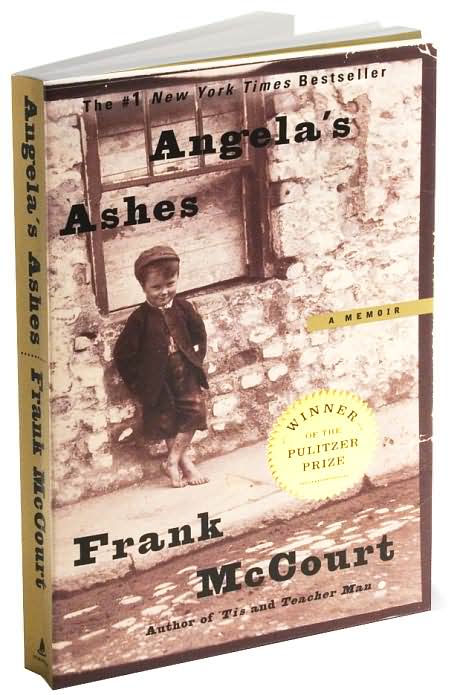
Angela's Ashes


written by Frank McCourt

Wow. Just... wow. I had heard that this book was intense, and I had been wanting to read it for a while now, but oh my word. I was not prepared for how desperate Frank McCourt's Irish Catholic childhood was. It was so eye-opening, to read this man's very personal story of growing up in the poorest of poor slums in Limerick, Ireland.

The memoir chronicles the story of how Frank's parents met and married, his early years as the eldest child in an Irish immigrant family in New York, the family's return to Ireland, and the many desperate events and circumstances that characterized his life as he grew from boyhood into being a young man of his own.

In my opinion, it's an important book to read because most of us have no idea what it's like to live without comforts and trappings. But do be aware that the book has some unsavory explicit parts that aren't appropriate for younger readers.

Really cool elements:
  • I admire McCourt for finding humor and joy in a most unexpected place: a childhood plagued by alcoholism, depression, loss, and astonishing poverty. Amazingly, though the book documents some very sad events, it doesn't really feel like a sad book. It's a beautiful testament to the resilience of the human spirit. I guess it's because the way McCourt chooses to muscle through his struggles, learning and growing all the while, rather than allowing them to define him and victimize him. I hope at the end of my life I can say that I did the same. (Though after reading his story, I have a hard time pointing to any area of my life that would qualify as hardship.)
  • I've heard some complain that the book could be shortened by at least a few hundred pages because of the repetitive stories of McCourt's father's alcoholism. I disagree. I think to take out any of those portions of the book would be to downplay the severity of the disease and its impact on the family. Malachy McCourt struggled mightily to stay off the Guinness and hold a job, and though he seemed to love his family, his alcoholism made it impossible to provide for them, materially or emotionally. After knowing a few families who have been similarly broken by alcoholism, I'm all for McCourt telling it like it is, painful details and all.

Not-so-cool elements:

  • McCourt writes the entire book from a child's point of view, which means the story is somewhat stream-of-consciousness, with very few complete sentences and only about half the required punctuation. If that kind of thing bugs you, you might find it kind of tedious to get through the book.
  • Maybe I missed something, but I don't get the title. I know the book is as much about Frank's mother (Angela) as it is about himself, but where do the ashes come in? I guess I thought there would be something about his mom dying and him doing something with her ashes, but there's nothing like that. Or is the title a reference to the ashes of the Woodbine cigarettes she always smoked? Or maybe the cold ashes in the fire, since the family always lacked enough fuel to have a warm, cozy home? I don't know — I didn't see a strong enough connection to figure it out.
  • The book ends kind of weird. The final installment in McCourt's memoir depicts him finally making his way back to America at age 19 to secure gainful employment. He immediately has a fling with a married woman, and that's the end of the book. It's not that I think he should gloss over this or pretend it didn't happen — this is a memoir after all, and if it happened, it happened — but it was such a disappointing ending. Is he implying that after all he's been through, he's really the boss of himself now and can do what he wants? Or that he's become enlightened enough to be above the church-manufactured sin/guilt complex that plagued him as a child? I don't know. I just know that I would've liked to see more profundity — some kind of significant parting statement, I guess — after such a provocative book. I wanted to find out more about whether he found fulfillment and purpose once he returned to America, and how he gained some closure to his fractured family relationships. But I guess that's what second books are for. Guess I have to add 'Tis to my library list...

Sunday, August 20, 2006

Promise Me

written by Harlan Coben

This is apparently a revival of Coben's oft-used hero, Myron Bolitar. I haven't read any of Coben's previous books, but I do know that many people rave about the Myron Bolitar series.

The book opens with Bolitar telling two teenaged girls (one is the daughter of a friend) to call him if they ever find themselves in trouble or need a lift, especially to avoid riding with a drunk driver. Of course, one of them ends up taking him up on his offer, and he gives her a ride to her "friend's" house in the middle of the night. When she turns up missing the next morning, Myron (who was the last person known to be in contact with the girl) finds himself embroiled in a sticky police investigation in which he may be implicated for abduction. Suddenly a sports-agent-turned-crime-sleuth, Myron gets to the bottom of the mystery and pretty much saves the day.

Not-so-cool elements:


  • Is it just me, or is the plot unnecessarily complicated by about a million different two-bit characters? And many of the characters are so over-the-top silly that they seem like caricatures. Almost like you're reading a comic book.
  • Coben goes overboard with sexual references. Can't a book be intriguing without all the trash?
  • Some of the lines in this book are just pure cheese. It's like the literary equivalent of a really bad Stephen Seagal movie. For example: "His worn blue jeans hung low, displaying enough plumber crack to park a bike." Sigh.
  • I think a good mystery book should be at least halfway believable. This one just wasn't. The twist at the end felt particularly contrived.

Cool elements:

  • I have to give Coben credit for the way he can hook a reader and maintain interest. Maybe he took lessons from James Patterson. Their books are like train wrecks -- you know they're horrible but you just can't look away.

Thursday, August 17, 2006

Housebroken: Confessions of a Stay-at-Home Dad

written by David Eddie

This was another twenty-five-cent find at the library's used book sale. It caught my eye because Jay and I are good friends with a couple in which the dad is the stay-at-home parent. The book looked funny and I thought I might read it and pass it along to our friends.

Lesson learned: there's a reason why certain books are sold for only twenty-five cents at used book sales.

Well, no, actually this book isn't all bad. There are a lot of redeeming elements that are hilarious, touching, philosophical, even thought-provoking. There's also a surprisingly useful 20-page stretch in which the author pontificates about how to cook -- portions of which are, in fact, making me contemplate hanging onto the book instead of feeding it back into the book donation bin for the library's next used book sale.

Cool elements:
  • If you are a stay-at-home parent (male or female, doesn't matter) you will find a lot of humor here. Eddie covers all the typical woes of parenting: sleep deprivation; disobedient children; kids' impact on your marriage; the mental toll of interacting with people under five years old, all day every day; the "what-do-you-do-all-day" question asked by well-meaning but clueless friends... and he does it in a way that you can really identify with. His style reminds me of a machismo version of the Girlfriends' Guide series of books by Vicki Iovine.

Not-so-cool elements:

  • In too many places, Eddie tries just a little too hard to be funny. I got tired of hearing him prattle on, sometimes boastfully, about what a raunchy cad he was (and still would be, if it weren't for having children) in his pre-fatherhood days. In fact, it was annoying enough that I almost pitched the book after the first few chapters. It also caused me to decide not to pass the book on to our friends that I mentioned above. The good and funny parts are offset too much by the overly animated retelling of his days of womanizing, drug use, and general irresponsibility.

Thursday, August 03, 2006

Marley & Me: Life and Love With the World's Worst Dog


written by John Grogan

This is a funny, sweet, poignant book. One that I devoured in just under two days -- which is a real feat, I assure you, considering how our willy-nilly summer schedule is busting at the seams with kids' activities, barbecues, beach outings, work commitments, houseguests, and of course everything that goes into doting on our own canine prince, Buster.

The book made me laugh and cry, sometimes simultaneously. This is, I think, because about a year ago I became a Dog Person. It's not that I didn't like dogs before that -- in fact, as a kid growing up in rural Dexter, I almost always had one of our family dogs by my side. Dogs occupy a well-deserved place in my long list of happy childhood memories.

But until July 2005 I had never had a dog of my own, as an adult. Never had a dog that depended on me and me alone for safety, food, shelter, and love. So it was with some serious deliberation that Jay and the kids and I added Buster to our family after studying his "please adopt me" posting on www.petfinder.org. We haven't looked back since. We are smitten with him, all of us.

So I know where John Grogan's coming from when he says, "A dog has no use for fancy cars or big homes or designer clothes. Status symbols mean nothing to him. A waterlogged stick will do just fine. A dog judges people ... by who they are inside. A dog doesn't care if you're rich or poor, educated or illiterate, clever or dull. Give him your heart and he will give you his... Sometimes it took a dog with bad breath, worse manners, and pure intentions to help us see."

Grogan really tells two stories in this book. One story is of a hilarious, crazy, misbehaved hundred-pound retriever and how he turns the life of his master into an unpredictable, embarrassing, expensive, messy labor of love. The other story is how man's best friend captures the heart of his master and teaches him a thing or two in the process.

Really cool elements:
  • Naughty dogs like Marley are pretty funny all on their own. (Especially when they're not yours!) John Grogan's wonderful, easy style and storytelling ability make them even funnier. You will laugh out loud at some of the stories in this book. And if you've ever owned a naughty dog yourself, you will see yourself in many of these stories. You might even find that you too are part of what Grogan calls the "Bad Dog Club."
  • Any pet owner knows that one of the most difficult parts of having a pet is coping with the eventual death of an animal that was a special and important part of life. The end of the book describes in tender detail -- with just enough levity to keep it from getting too depressing -- how the Grogan family worked through Marley's aging and death. It's really a pretty beautiful account of how a family deals with loss.
  • Grogan gives ode to Marley's life by describing how he "was a central player in some of the happiest chapters in our lives... chapters of young love and new beginnings, of budding careers and tiny babies. Of heady successes and crushing disappointments, of discovery and freedom and self-realization. He came into our lives just as we were trying to figure out what they would become." I love how the story of Marley was inseparable from the story of this man's life: his marriage, his children, his work, his friendships. Dogs are like that. Dogs are just ... cool.

Not-so-cool elements:

  • Being a Dog Person, I really can't think of anything in the book to complain about. Except for the fact that the story might be lost on Non-Dog People. So if you're not into dogs, you might want to just skim. I can see a Cat Person trying to get through this book and thinking, "Please. Do we really need to know about every couch-eating incident? Every embarrassing moment in the dog obedience class? Every instance of finding some bizarre foreign object in the piles that Marley deposited in the back yard?" If you're not into dogs, the book might feel a little like listening to some over-involved parent prattling on about their wonderful children, when anyone with eyes can see that the kids are little demons who would be better off at reform school.

Saturday, July 15, 2006

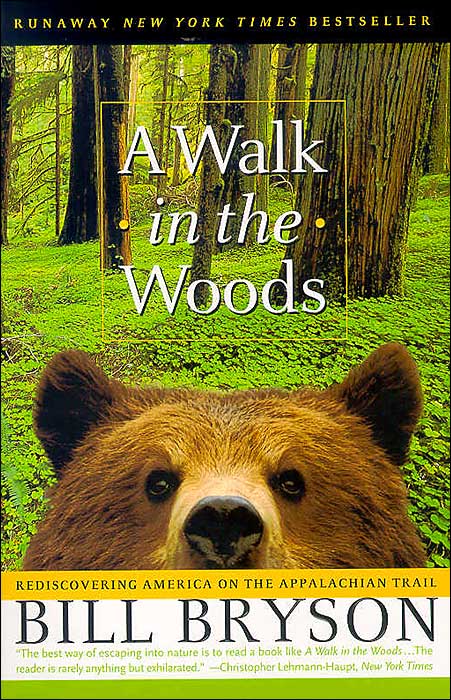
A Walk in the Woods

written by Bill Bryson

There are few books that appeal to me enough that I read them multiple times. This is one of them. I think I've had a copy of A Walk in the Woods on my bookshelf since 1999 — not the same copy all that time, mind you, because I keep giving this book away and re-buying it. It's that good.

I know you're probably thinking that, since I kind of have a thing for hiking, any book about the Appalachian Trail would earn a permanent spot in my library. Not so. In fact, the only other AT book I own is the austere but sensible Appalachian Trail Data Book which, in 74 pages (each crammed with five narrow columns of 6-pt. font), lists every shelter, water source, road crossing, campsite, and other point of note along the 2200-mile Trail. Helpful, but not exactly something you keep on your nightstand for pleasure reading.

In the category of more prose-y AT books, there are lots of titles out there, and trust me, most of them aren't worth hanging onto — reason being, they're written by hikers who decide to try their hand at writing. Bill Bryson, on the other hand, is a writer who decides to try his hand at hiking. The result is a wonderfully easy read that gives you a taste of what it's like for an ordinary joe to attempt a very big hiking trip.

I hadn't read the book in a while but picked it up again earlier this summer, after returning from a seven-day hike on the Appalachian Trail through Great Smoky Mountains National Park. I was prompted to re-read it — this was probably my third or fourth time — because while hiking through Newfound Gap, another hiker remarked to me, "Hey, now we can say we've made it further than Bryson did." (Bryson abandoned his lofty ambition of "thru-hiking" the 2200-mile trail after the first few hundred miles.) Since the story details a lot of Bryson's impressions of the very section of the trail I had just finished, I really wanted to go back and compare his experience with mine.

The book tells of how Bryson first learns of the trail ("Not long after I moved to New Hampshire I happened upon a path that vanished into a wood on the edge of town..."), how he enlists the companionship of the wayward but loveable and out-of-shape Stephen Katz, and their colorful experiences as they seek to conquer "the granddaddy of long hikes."

Not-so-cool elements:
  • Some AT purists out there would have you believe that since Bryson aborted mission after the first few hundred miles, he's a complete failure who has no business telling others what it's like to hike the Trail. These same people are usually the ones who also lose sleep over the fact that Katz commits the indecent act of unashamedly littering in the wild by flinging coffee filters, brown sugar, cheese, peanuts, and Spam into the woods in a desperate attempt to lighten his backpack. And! Bryson commits the equally egregious act of recounting all this as a string of wildly humorous anecdotes. To anyone upset by this, I must just say: Come. On. People. Not that I at all condone the mistreatment of our environment, but please. Lighten up. It's a book. And the guy is trying to be funny.
  • If you're looking for a blow-by-blow guidebook-style account of everything you'd encounter on the AT if you hiked from the top of Springer Mountain to Newfound Gap, this isn't it. Having hiked the same stretch that Bryson did, it's interesting to notice not only what Bryson chose to include in his book, but also what he chose to omit. I guess it's evidence that, as my friends on Whiteblaze are fond of saying, everyone's gotta hike their own hike.
  • Bryson is very critical of the National Park system and their efforts at conservation. I found this a little off-putting, especially after spending a fair amount of time hiking alongside park service employees who have laid down their very lives to care for the woods and the trail.
  • Bryson is none too complimentary of southern culture. Being a Yank myself, I have to admit that I share some of his prejudicial impressions. Just know that if you live south of Cincinatti, it's likely that you'll take offense at some of the jabs he makes.
  • The cover of the book leads you to believe there's a great bear story here. There isn't. The first time I read the book, I kept waiting to get to the part about the bear, and it never came. That did bug me some.
Really cool elements:
  • Even if you've never hiked a mile in your life, you'll enjoy this book because so much of it is more about the human experience than about hiking, or about the AT. While Bryson wittily describes his foray into the wilderness, he also gently and humorously opens up all kinds of sensitive topics, including conservation of our fragile environment, our astonishingly sedentary culture, friendship, and loyalty. Even alcoholism gets some air time in this book. There's a lot more here than just a funny travelogue.
  • If you've never been out in the wild for days on end, away from creature comforts, or if you've ever casually wondered, "How would it be to subsist on dehydrated food and Power Bars while walking up and down mountains until my feet resemble hamburger," this book is a great low-risk method of exploring such things. Though Bryson, like any author, takes some artistic license in his storytelling, his account of the AT is, in my estimation, pretty true to life.
  • I love books that are funny and easy to read but still have interesting story lines and concepts that stretch one to think a bit. Bryson's satiric wit and Dave-Barry-ish writing style make this feel like an easy read. But he inserts enough societal and relational issues that you feel like it's also a good-for-you kind of book.

Friday, June 16, 2006

Airframe


Written by Michael Crichton

When I first started reading this novel, something about it felt suspiciously familiar. But since there are a slew of plane-crash disaster stories out there, I figured maybe I'd read something similar once. About halfway through, though, I realized that I had read this book, or at least part of it, maybe ten years ago. The details were hazy in my memory, and I don't think I ever finished it. Which should have been a warning sign. It's a pretty slow, lackluster story.

In a nutshell: a flight from Hong Kong to Denver unexpectedly starts "porpoising" — pitching violently up and then down several times. End result: four people dead, 56 injured. Casey Singleton, a nice, wholesome midwestern type who has managed to make her way to a VP position at Norton aircraft (the builder of the plane), is assigned the duty of investigating what went wrong. While she's unraveling the myriad of details related to the accident, a bitter labor dispute is brewing, and an investigative news program is trying to expose Norton as a negligent, money-hungry corporate beast that has no regard for passenger safety.

Really cool elements:
  • I loved the way Crichton makes fun of the media. The television people in this story are of the "60 Minutes" variety. Crichton has some fun developing their characters as shallow, finger-pointing monsters who are only interested in sensationalizing the accident for the sake of their ratings.
Not-so-cool elements:
  • There was an awful lot of technical detail, without much explanatory help for those of us who don't build or service airplanes. Lots of acronyms too (which I'm sure is reflective of real life in the airplane-building industry). Maybe I'm just not enough of a gearhead to get my brain around all the details, but I found it easy to get bogged down.
  • Some of the subplots just end up going nowhere. For example, in the first half of the book, some of Norton's union thugs are out to get Casey; the company even assigns 24-hour bodyguards to trail her every move. But we never find out anything concrete about the thugs who lurk in the dark hangar corners, and we never hear any more about the guards (wouldn't they kind of have an impact on her daily life?)
  • The ending really lacked punch. After 350 pages, I felt like I deserved a much more exciting explanation for why the plane nosedived.